When averages stop being fair - Understanding why ORC offers more than one way to score a race

6 January 2026 - by Thomas Nilsson - This article is the first in a short series where we will explain the thinking behind the different scoring options available in ORC.
A series on ORC Scoring Options
Over the years, ORC has developed several ways of scoring races – not to make racing more complicated, but to make racing more fair. Sailing is inherently variable. Wind strength changes, angles shift, sea state evolves, and courses are rarely identical from race to race. In that reality, a single average number cannot always describe what actually happens on the water.
In some cases, relying only on a “one-number” rating does not just simplify reality – it can actively distort results.

In this first article, we look at why averages sometimes stop being fair, and why understanding how boats behave is the foundation of the ORC system. In the following article, we will take a closer look at the practical scoring options ORC offers – what they are, when they are used, and how they help produce results that better reflect the racing that actually took place.
ORC does not add complexity for its own sake. It simply recognises a basic truth of sailing: when conditions vary, fairness often requires more than a single number.
When averages stop being fair
A single number is, by definition, an average. And averages can hide a lot.
They can favour boats optimised for one condition and quietly disadvantage others when the weather doesn’t match the assumed “middle ground.” For example, a boat that thrives in light air may be penalised when the breeze builds. And a design that excels upwind may lose out when reaching dominates the course.

Over a long season, these effects may even out. Yet over a race or a weekend, or a championship, they often do not. It can get frustrating to anticipate race results before even leaving the dock due to this effect.
This is not a flaw in the boats – and it is not a flaw in the sailors. It is simply the result of trying to compress a three-dimensional, constantly changing sport into a single figure.
For decades, many handicap systems have relied on this simplification. And in many cases, it can work reasonably well. But as designs evolve and racing becomes more competitive, the limitations of a single-number approach become more visible.
The key question then becomes:
Is there a better way to reflect what actually happens on the race course?

It begins with knowing how boats behave
At the heart of ORC is the Velocity Prediction Program – the VPP.
Rather than producing a single one-size-fits-all number, the VPP creates a full performance picture of each boat. How fast it sails upwind, reaching, and running. How it responds to light air, medium breeze, and heavier conditions. How its performance shifts as wind angle and wind speed change.
In other words, the VPP doesn’t ask:
“How fast is this boat?”
It asks:
“How does this boat sail?”
That distinction matters.

Because once you understand how a boat behaves across a wide range of conditions, you are no longer forced to pretend that all races take place in some imaginary average breeze on an average course.
You can acknowledge reality instead.
From understanding performance to scoring races
Once you have a full performance profile for each boat, the obvious next question becomes:
How should that information be used to score a race?
- Should all races be treated the same, regardless of whether they were sailed in drifting conditions or fresh breeze?
- Should a long offshore leg be scored the same way as a short windward-leeward course
- Should boats be compared using an average number, or using the part of their performance that was actually relevant on the day?
ORC’s scoring options exist precisely to answer these questions.
They do not change the boats.
They do not change the measurements.
They do not reward observed performance.
What they do is allow organisers to choose a scoring method that better matches the type of race being sailed and thus produce more fairness in the fleet.

Not more complex — just more honest
From the outside, multiple scoring options can look like added complexity. In reality, they are a response to complexity that already exists on the water.
Sailing is not sailed at an average wind speed.
Races are not sailed at an average angle.
Championships are not sailed in average conditions.
The approach ORC makes to scoring simply reflects that reality.
By moving beyond a single average number, the system aims to produce results that are not just mathematically tidy, but meaningful – results that sailors recognise as fair when they look at the scoreboard and think back to what actually happened on the course.
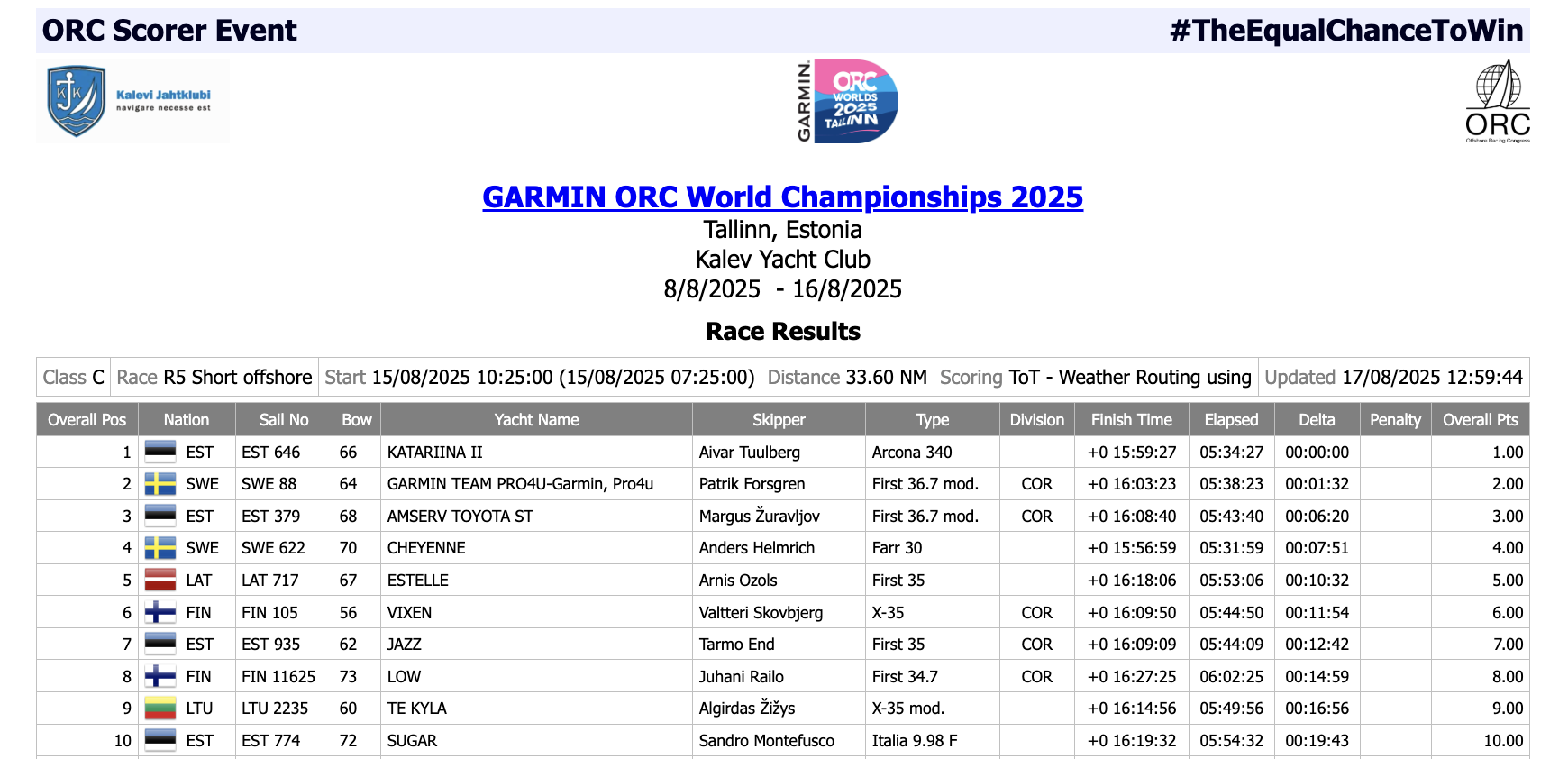
What comes next
In the next article in this series, we will look more closely at the different ORC scoring options themselves – how they work, when they are typically used, and what kind of racing they are best suited for.
For now, the key idea is simple:
Fair scoring starts with understanding how boats behave – and fairness sometimes means accepting that one number is not enough.

Related articles