When the Course and the Weather Become Part of the Scoring
 Leer en Español

Written by Thomas Nilsson - In the previous two articles, I explored how ORC ratings work and why scoring choices matter.
First, we saw why relying solely on averages can sometimes distort results. Then we looked at the practical tools most sailors know best: Single Number scoring, with a choice between Time-on-Distance and Time-on-Time.
Those tools are widely used — and for good reason. They are robust, simple to administer, and work well in many racing situations. But they are still built on an approximation.
They assume that the race sailed resembles the theoretical “average race” behind the chosen Single Number. What happens when that assumption is no longer good enough?
This is where ORC’s scoring methods move one step closer to reality.
One Rating Matrix — One Number for the Race
At this point, it is important to clarify something fundamental.
Even when using PCS (Polar Curve Scoring) or Weather Routing Scoring, the result is still Single Number scoring.
The corrected time is always calculated using a single TCF — exactly as in APH or other familiar formats. The real question is not whether we use a single number.
The question is:
How do we choose the right single number from the full rating matrix?
Because that matrix — produced by the VPP — already contains the answer.
It describes boat performance across all wind speeds and wind angles.
When the Course Matters
Real races rarely resemble the theoretical models behind Single Numbers as APH.
Courses may include:
long-reaching legs
coastal transitions
asymmetric layouts
shifting wind patterns
If we assume that all boats sail the race in broadly the same conditions, we can describe the race more precisely. This is where PCS Constructed Course scoring comes in.
PCS Constructed Course
With PCS Constructed Course, the race is defined through:
course distance
leg lengths
sailing angles (bearings relative to wind)
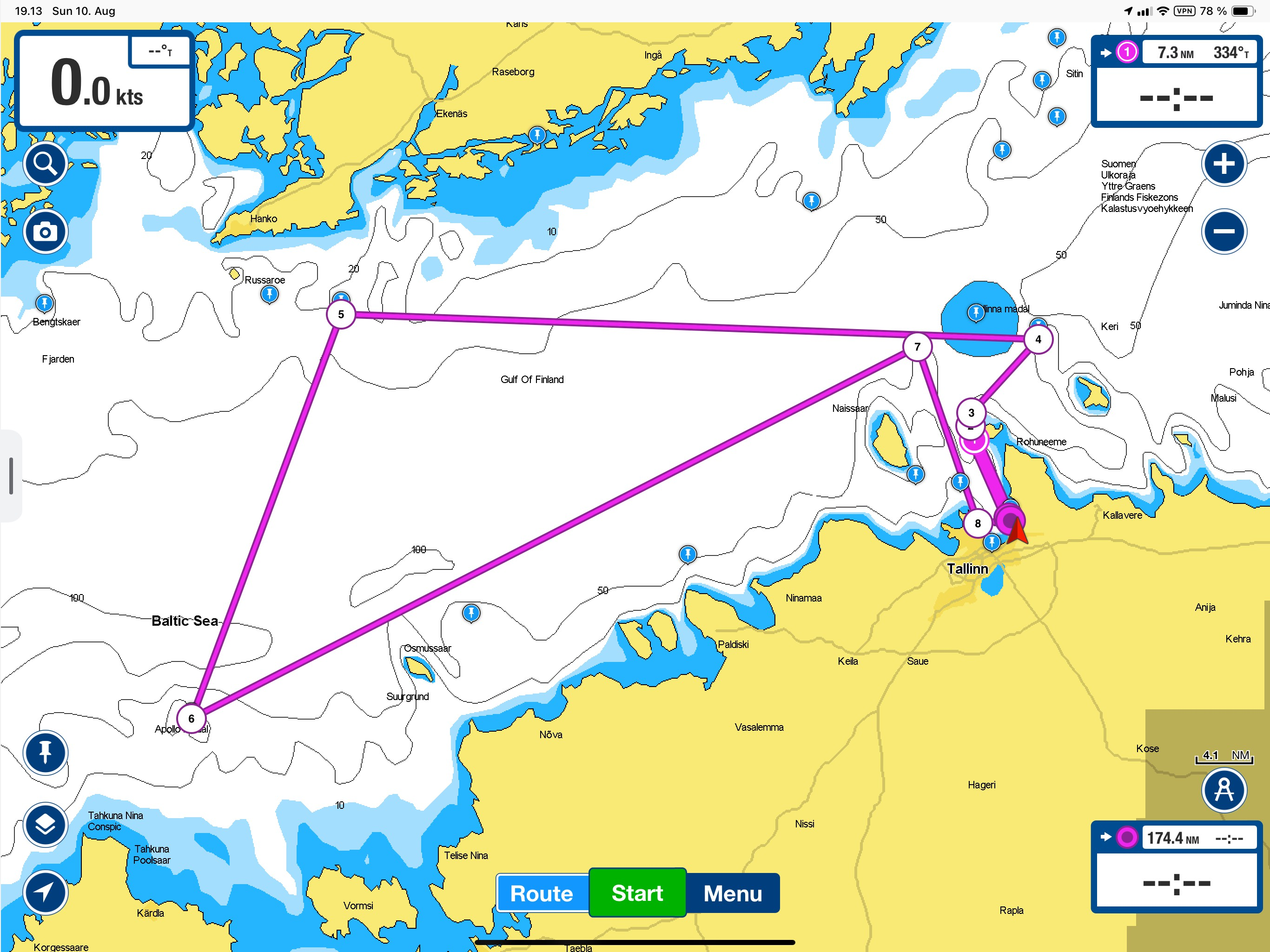
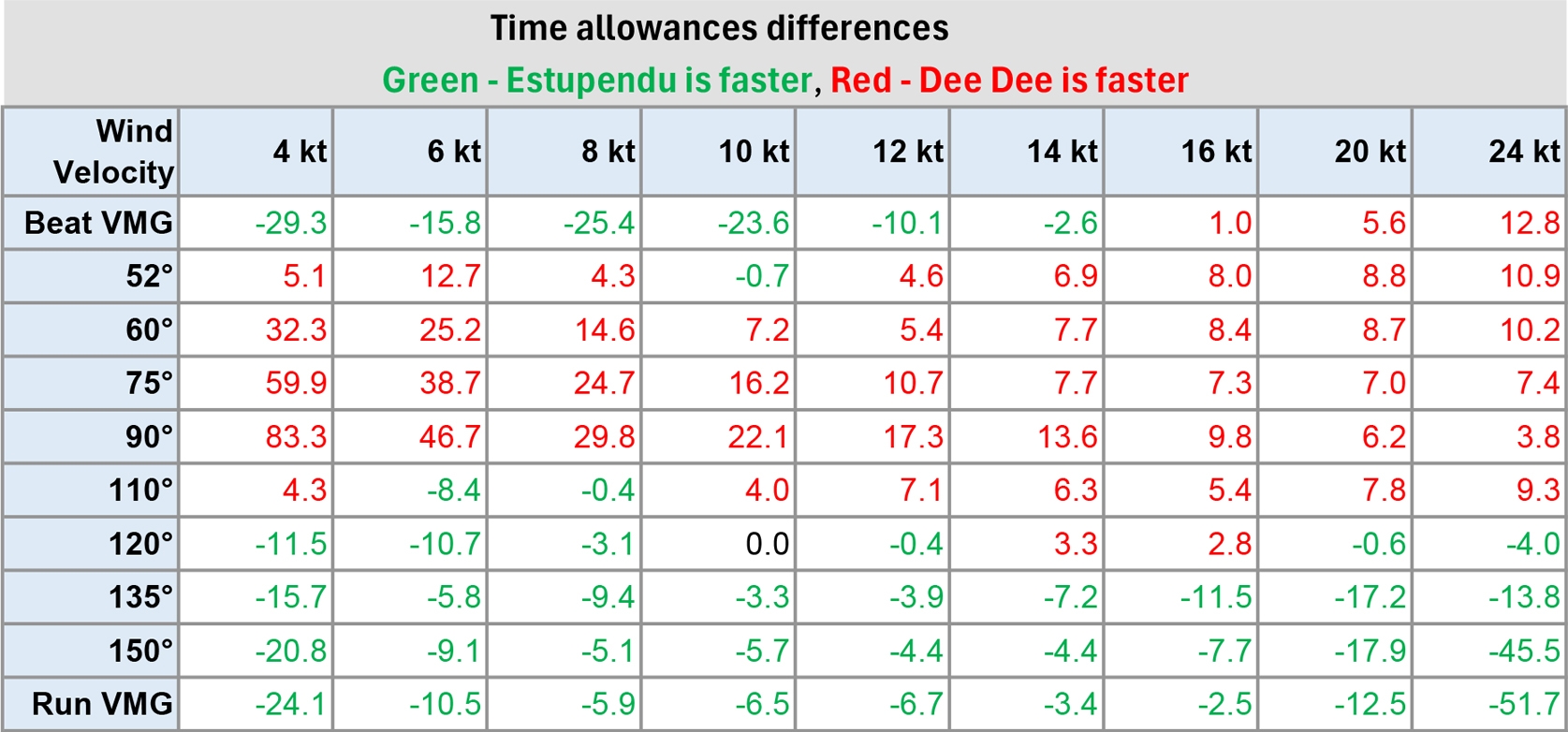
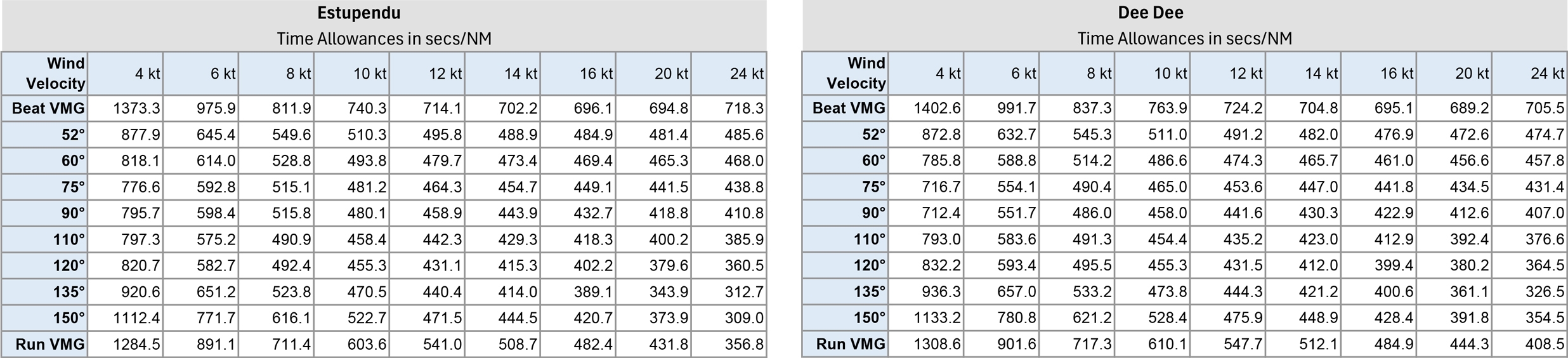
Importantly, in PCS the wind is not directly defined as an input. Instead, it is derived from the race itself — often referred to as the “scoring wind” — based on how the fleet has sailed the course.
In simple terms:
We are still using a single number — but it is now a number derived from the specific course that was sailed, rather than an average. This approach works best when:
boats experience similar conditions
the course geometry is well defined
fairness is driven by how boats perform across different angles on the same course
When Conditions Are Not the Same
However, not all races are sailed in uniform conditions.
In longer races, offshore races, or events with shifting wind systems:
some boats may sail in more wind
others in less
some may experience different wind angles
In these situations, describing the race with one fixed set of conditions becomes less accurate.
We cannot reconstruct the exact conditions for each boat after the race. But we can do something else.
Weather Routing Scoring
With Weather Routing Scoring (WRS), typically for longer races (around 6 hours or more), we use the best available forecast before the race to estimate how conditions are expected to evolve over time. Based on this forecast, the system defines the race as a constructed course made up of segments, where each segment includes:
leg length
wind direction (TWD)
boat heading (bearing)
and wind strength (TWS)
In this way, WRS works in a similar framework as PCS, but with wind conditions explicitly defined for each part of the course based on the forecast. Using this, the system simulates how each boat is expected to sail the course. From this, a single number is calculated for each boat, reflecting its expected performance in those conditions.
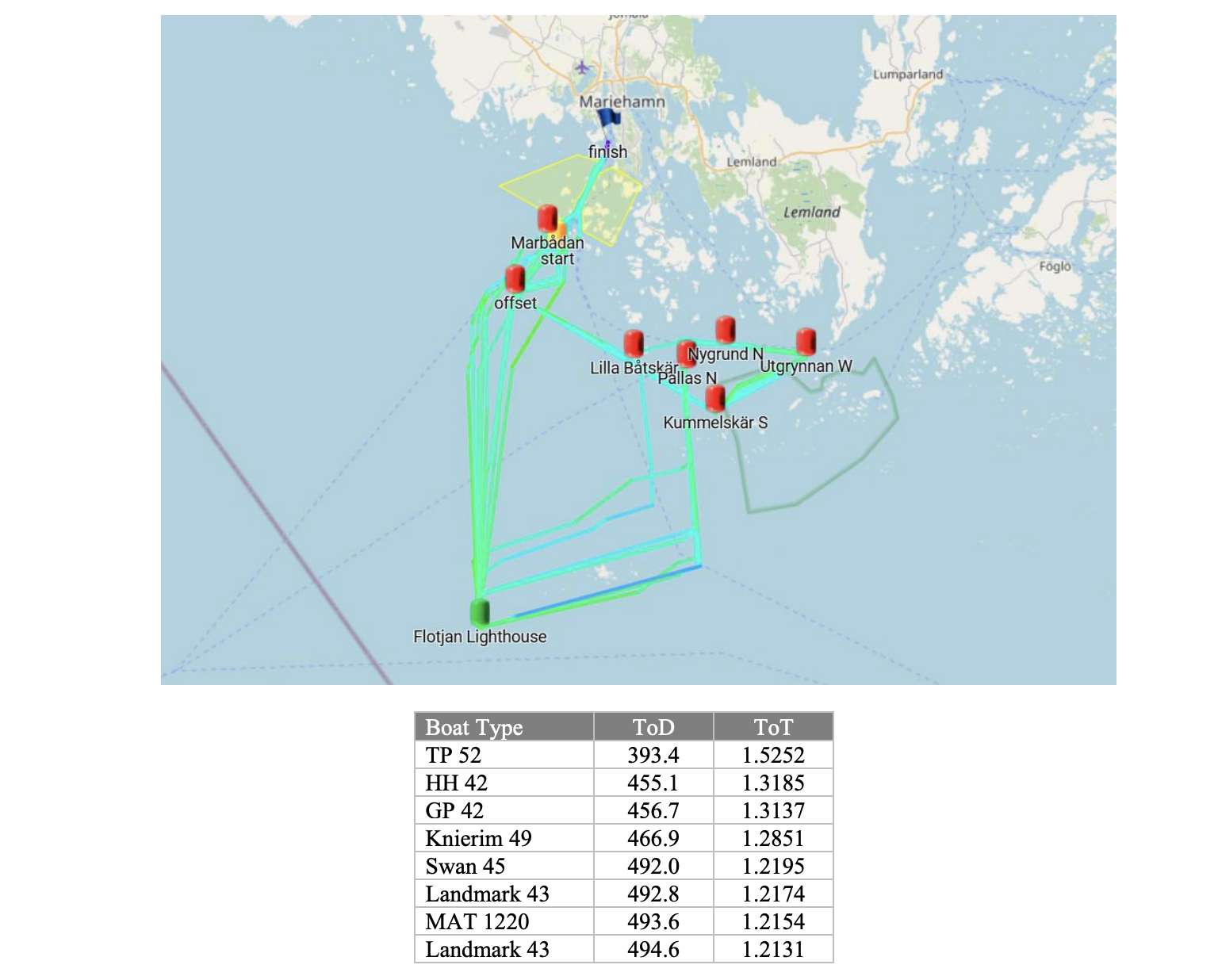
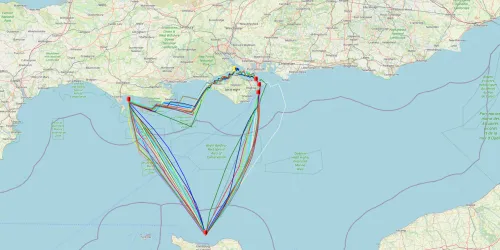
An example of weather routing the fleet on the offshore race with ToD and ToT ratings calculated.
Different track colours indicate different predicted speeds.
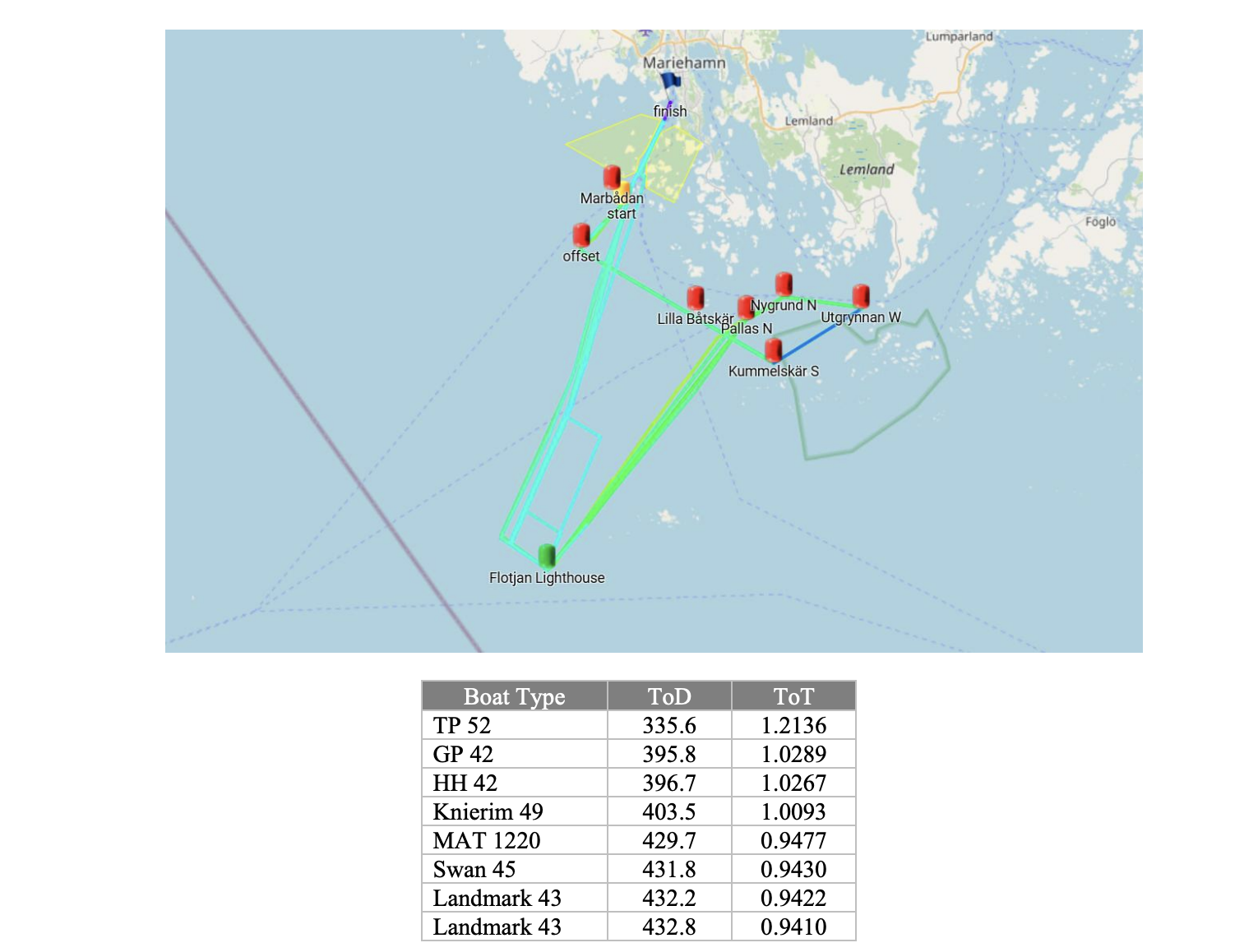
Different wind conditions are giving different routing and different ToDs and ToTs for the same race
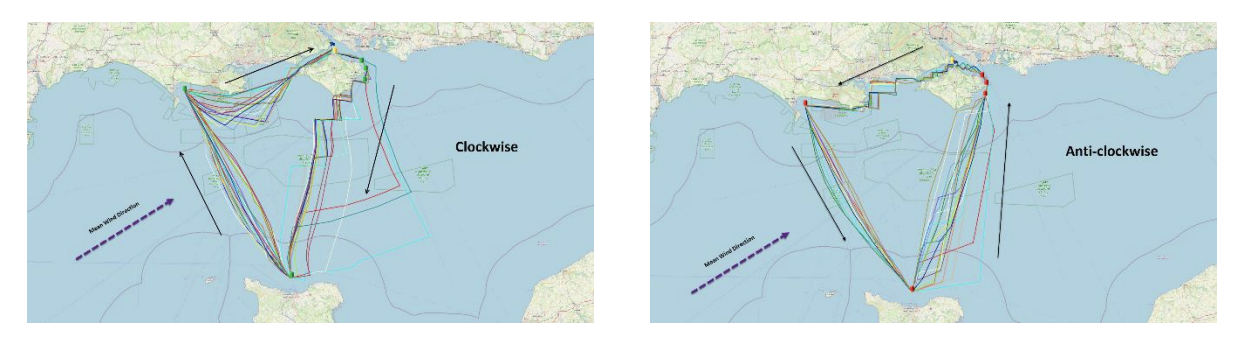
Applying single number ratings will be the same rating for both races, but Weather Routing Scoring gives different ratings as wind conditions are different in each direction of the course sailed.
Again, the key point is this: We still end up with one number per boat.
But now that number is based on an estimate of the conditions each boat is expected to sail in, rather than assuming identical conditions for the entire fleet.

Boats Are Not Constant Machines
The reason this matters is simple. Boats are not constant machines. They respond differently to:
wind strength
wind angle
course geometry
Two boats with identical average ratings may perform very differently depending on the conditions. The VPP matrix captures these differences. PCS and WRS simply provide two different ways of selecting the right part of that matrix.
Two Approaches, Same Logic
Seen this way, PCS and WRS are not fundamentally different systems.
They are two approaches to the same problem:
How do we extract a fair single number from a performance matrix covering all wind speeds and angles?
PCS assumes the same conditions for all boats and defines the race through the course
WRS acknowledges that boats may experience different conditions, and uses the forecast to approximate that reality
Both methods remain fully consistent with the core ORC philosophy.
Not More Complex – Just More Precise
From the outside, this may look like added complexity. In reality, it is simply a more precise way of asking the same question. Single Number scoring is still there. The only difference is how we choose the number.
And once that choice is made, the scoring software performs the calculations — ensuring that the results are handled consistently and transparently for all competitors.
Closing the Circle
Across this series, we have moved step by step through the logic of ORC scoring.
We started with averages. We then looked at how those averages are applied. And finally, we arrived at the tools that allow us to move beyond them when needed. Seen together, these are not different systems. They are different levels of precision. And they all serve the same purpose:
To make the results reflect what actually happened on the water.
All three articles available at https://orc.org/race-managment/scoring

Related articles